Below are five free, open-source starters, read from their own repositories on 12 October 2026. All five are MIT licensed, which allows commercial use.
At a glance
| Starter | Auth | Database | Payments in the free version | Best for |
|---|---|---|---|---|
| Next.js SaaS Starter (Vercel) | Email and password, JWT in cookies | Postgres with Drizzle | Stripe Checkout and Customer Portal | Learning how the pieces fit |
| SaaS Boilerplate (ixartz) | Clerk | Drizzle on Postgres, SQLite or MySQL | No (Stripe is in the paid tiers) | Teams, roles and i18n from day one |
| create-t3-app | NextAuth.js | Prisma or Drizzle | No | A typesafe base you assemble yourself |
| GetShipKit | Clerk | Supabase (Postgres) | Polar.sh subscriptions | Charging for a small product quickly |
| Open SaaS (Wasp) | Email and social logins | Prisma | Stripe or Polar.sh | Not Next.js: React and Node on Wasp |
Next.js SaaS Starter, from Vercel
The official example in the nextjs/saas-starter repository: Postgres through Drizzle, email-and-password authentication with JWTs stored in cookies, a pricing page connected to Stripe Checkout, and subscription management through Stripe's Customer Portal. You run Stripe's CLI locally to receive webhooks.
Its README is candid about what it is: "intentionally minimal and to be used as a learning resource." That is its strength. It is the clearest way to see how auth, a database and Stripe fit together in current Next.js, and you will be adding social logins, email and the rest yourself.
SaaS Boilerplate, from ixartz
The broadest free option: Clerk for authentication, multi-tenancy with teams, roles and permissions, internationalization, Drizzle across Postgres, SQLite or MySQL, Vitest and Playwright tests, Sentry error reporting and GitHub Actions. It is on Next.js 16.
The catch is in its own comparison table: Stripe integration is ticked for the paid Plus, Pro and Max versions and not for the free one. The free code also carries PRO comments marking what is reserved. If you need a B2B structure and will add billing yourself, it is a strong base.
create-t3-app
create-t3-app is a CLI more than a template: npm create t3-app@latest asks which pieces you want (Next.js, tRPC, Tailwind, Prisma or Drizzle, NextAuth.js) and generates a project with just those. Its README says plainly that it is "NOT an all-inclusive template."
There is no billing and no dashboard. Choose it when you want end-to-end type safety and would rather choose your payment provider than inherit one.
GetShipKit
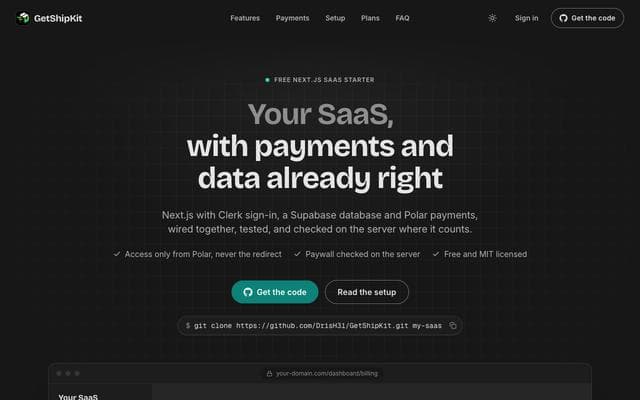
GetShipKit is the starter DrisH built and gave away. It is opinionated about one stack (Clerk for auth, Supabase for the database, Polar.sh for payments), so the three are already talking to each other: Clerk users sync to Supabase so row-level security can use the signed-in user's ID, Polar's checkout and webhook route are in place, and a Manage Subscription button opens Polar's customer portal.
- Next.js 15 App Router in TypeScript
- The whole database schema in one
schema_export.sqlyou paste into Supabase's SQL editor - Tailwind CSS and DaisyUI, a web manifest for installing it as an app, and a sitemap and
robots.txtgenerated on build - Free tiers on all three services to start
Its narrower scope is the trade: no teams or roles, no i18n and no test suite. It suits a solo developer who wants to take payments for a small product this week.
Open SaaS, from Wasp
Worth knowing about, with one caveat for this list: it is not Next.js. Open SaaS is built on Wasp, a full-stack framework over React, Node.js and Prisma, and includes auth with email and several social providers, email sending, background jobs, S3 uploads, and payments through Stripe or Polar.sh. If you are not committed to Next.js, it is among the most complete free options.
And the paid ones
Commercial boilerplates such as ShipFast and Makerkit are one-time purchases with lifetime updates. On 12 October 2026, ShipFast's Starter was listed at $199 and Makerkit Pro at $299. They come with more pages, more integrations and support. The free starters above cover the core for nothing, and the difference is how much of the rest you are happy to build.
Which to choose
- To understand the moving parts: Vercel's Next.js SaaS Starter.
- For a B2B product with teams and roles: ixartz's SaaS Boilerplate, adding billing yourself.
- For a typesafe base and your own choices: create-t3-app.
- To take subscription payments on a small product quickly: GetShipKit.
- If you are open to a framework other than Next.js: Open SaaS.
FAQ
Are these Next.js SaaS starters really free for commercial use?
Yes. All five are MIT licensed, which allows commercial use; keep the license notice in your copy of the code.
Which free Next.js starter includes payments?
Vercel's Next.js SaaS Starter wires in Stripe, and GetShipKit wires in Polar.sh. ixartz's free version leaves Stripe to its paid tiers, and create-t3-app has no billing.
Which one uses Supabase?
GetShipKit, with Clerk connected to Supabase so database security can use the signed-in user. The others use Drizzle or Prisma against a Postgres database you provide.
Can I swap the payment provider later?
Yes, it is your code. In each starter, payments live in their own routes and a billing page, which is where a swap happens.
Is a free starter enough to launch a real product?
For the core (sign-in, data and subscriptions), yes. What you add is everything specific to your product, plus anything the starter leaves out, such as email or teams.