Telly case study: a weekend fork that made $85 in a month
Indie dev experiment: GitHub fork to paid Mac App Store listing in a weekend. App Store Connect data, conversion funnel and territory breakdown inside.

The idea behind Telly wasn't original. This post is about a distribution experiment and the data it produced.
The question
The hypothesis I wanted to test was narrow:
If I find an existing open-source macOS app, repackage it, and ship it to the Mac App Store under my own label, without building anything from scratch, how much money does it actually make?
Most indie-dev advice goes the other way: start with an idea, build the idea, ship the idea, hope the market shows up. That's a 3–6 month loop with a coin-flip outcome. I wanted the opposite: a loop short enough to measure, and cheap enough that a null result still teaches something.
The source
I opened GitHub and searched for macOS teleprompter. The Mac App Store has a teleprompter category that's surprisingly shallow: most apps are bloated, subscription-heavy, or designed for TV studios rather than someone recording a pitch on their MacBook. An opening existed.
A few results in, I found textream by @f, a small, clean macOS teleprompter, MIT licensed. Well-structured code, no dependency rot. That was the raw material.
The MIT license is the important detail. MIT permits commercial redistribution, with two conditions:
- The original copyright and permission notice must be retained in substantial portions of the source.
- The author takes no liability for how you use the code.
That's it. No royalties, no special permission, no separate agreement. Fork, modify, redistribute, charge for it: all allowed.
The modification
Cloning the repo took seconds. The work happened in four places:
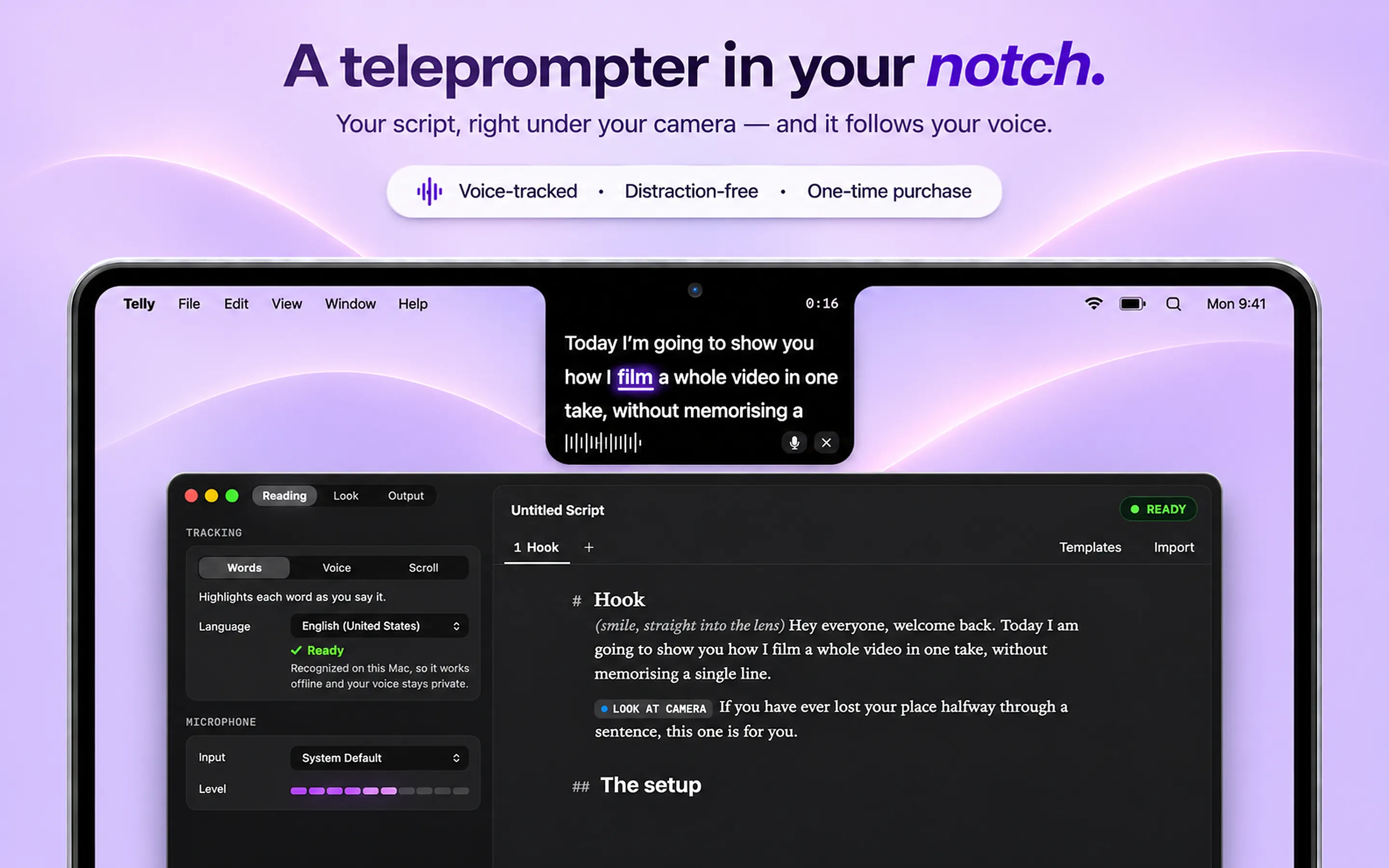
- The notch insight. textream's original UI scrolls text in a standard window. I repositioned the scroll region to live directly inside the MacBook notch, the narrow strip of screen right under the camera lens. That one move is the entire user-facing value proposition: your eyes stay on the camera while you read.
- The icon. New app icon, drawn from scratch to match the DRISH LABS visual language.
- The App Store metadata. Fresh name ("Telly"), tagline ("Teleprompter in the MacBook Notch"), product description, screenshots, category.
- Attribution. The MIT license text is bundled inside the app, accessible from the about screen.
textreamis credited as the upstream project. This is both a legal requirement and the right thing to do.
I shipped to App Store Connect on a weekend. Review took a few days. Live the following week.
The cost
Time invested
Cash invested
Lines of new code
Lines reused
The asymmetry is the whole point. ~150 new lines did the thing nobody else had done (put the text at the camera). The other 2,400 lines were already solved and sitting in public.
The result: 30 days on App Store Connect
All numbers below are from App Store Connect, period ending April 12, 2026. Dollar figures are rounded to the nearest dollar, so a breakdown can come to a dollar more or less than its total.
Proceeds
Price
First-time downloads
Redownloads
Impressions
Product page views
Conversion rate
Experiment status
The conversion funnel
Every App Store product works as a funnel. This is Telly's, end to end, for the same 30-day window:
Funnel, April 2026
The two drop-off ratios that matter:
- Impression → page view: 5.8% (5,010 → 290). About one in seventeen people who see the app in search or browse decide it's worth tapping the listing.
- Page view → download: 2.4% (290 → 7). Five of those seven were paying first-time downloads, so 1.7% of page views became a sale (290 → 5). For a standalone utility in a niche category, this is the number I'd iterate on next: better screenshots, a sharper first-paragraph description, tuned keywords.
Across the whole window, 0.14% of impressions became a download (5,010 → 7) and 0.1% became a sale (5,010 → 5). App Store Connect's own figure, 0.2%, is an average of daily rates, which is why it does not match the totals.
Where the revenue came from
App Store Connect breaks proceeds into two dimensions: how people found the app, and where they paid from.
Proceeds by source
82% of proceeds came from App Store search. I did zero marketing: no Twitter, no Product Hunt, no Reddit. That $70 is pure keyword demand against a category where the incumbent apps have mediocre listings. The $16 from "Web referrer" is the long tail of Google-indexed mentions, which I also didn't seed.
Proceeds by territory
Geography is the more surprising cut. The top four territories split $70 almost evenly: Germany, Thailand, US and India within $3 of each other. I had an intuition the US would dominate. It didn't. "MacBook owner who wants a cheap teleprompter" is a globally distributed user.
What this actually tested
Three things, in order:
- Distribution asymmetry. The Mac App Store is still a discoverable marketplace for categories where Google doesn't dominate. Search-rank on "teleprompter" drove 82% of every dollar I earned.
- OSS-to-product speed. The fastest path from "I notice a gap" to "I have a paying customer" is wrapping existing software with a sharp positioning insight and shipping it under a clean brand, rather than writing new software.
- Ethical commercialization of MIT code. If the license permits it and you credit the original author, nothing is being taken. The original project keeps its upstream. Any improvements you make can flow back, though MIT doesn't require it.
What I'm not claiming
Takeaway
I did not invent the teleprompter. I did not invent the idea of a lightweight Mac teleprompter. I did not write most of the code that runs Telly. The novel contribution is a ~150-line repositioning of the UI into the notch, plus the App Store packaging around it.
If you clicked here expecting "a genius writes 200 lines and ships", the real story is blunter: a builder notices an under-served App Store category, picks up an MIT-licensed open-source base, adds one specific insight, ships, charges money, attributes upstream. The returns came from distribution.
What I'd do differently
- Ship sooner. The notch idea was obvious the moment I looked at the MacBook; I spent two days polishing when I could have shipped in one.
- Set up attribution-in-app from submission. I added it cleanly at launch, but it should be the first commit after forking, not something I scramble to include before review.
- Instrument better. $85 is fine; $85 with no clue why Germany buys as much as the US is less fine. A single in-app "how did you find us" prompt would have paid for itself.
- Log the experiment live. I'm writing this a month after the fact, which means I'm reconstructing revenue from dashboard screenshots instead of having it in a doc. Future experiments: journal weekly.
The frame I'm using for the next one
What made this experiment cheap was starting with open source as the default building block. Every future shipping experiment will open with the question:
"Does an MIT or Apache-licensed project already solve 80% of this?"
If yes, the experiment is weekend-scoped and a revenue signal is measurable in a month. If no, it's back to normal scope. Either answer is fine. The pre-commit research just got an order of magnitude cheaper.
The second question I'll ask, which I didn't ask this time:
"Which App Store surface does this category actually live on (search, editorial, category browse, external referrer), and can my listing earn the top slot on that surface?"
For Telly, the answer was "search" and the category was thin enough that a modest listing ranked. Next category might not be. Knowing before you fork saves the 2 days.
Source project: textream by @f, an MIT-licensed macOS teleprompter. Credit and thanks to the original authors; Telly would not exist without their work.
Telly has grown well past this first version, with voice tracking, rig and OBS output, and captions. What it does today, and the download link, are on the Telly page.
Client work
Have something like this built
DrisH designs, builds and ships iPhone and Mac apps, websites and web apps for clients, start to finish. Say what you need, and the reply is a price.
Written by
DrisH
Independent software developer in India, and the founder of DRISH LABS — utility software across macOS, iOS, and the web, built and shipped alone. The catalog is the public record.