

What is Mishkāh?
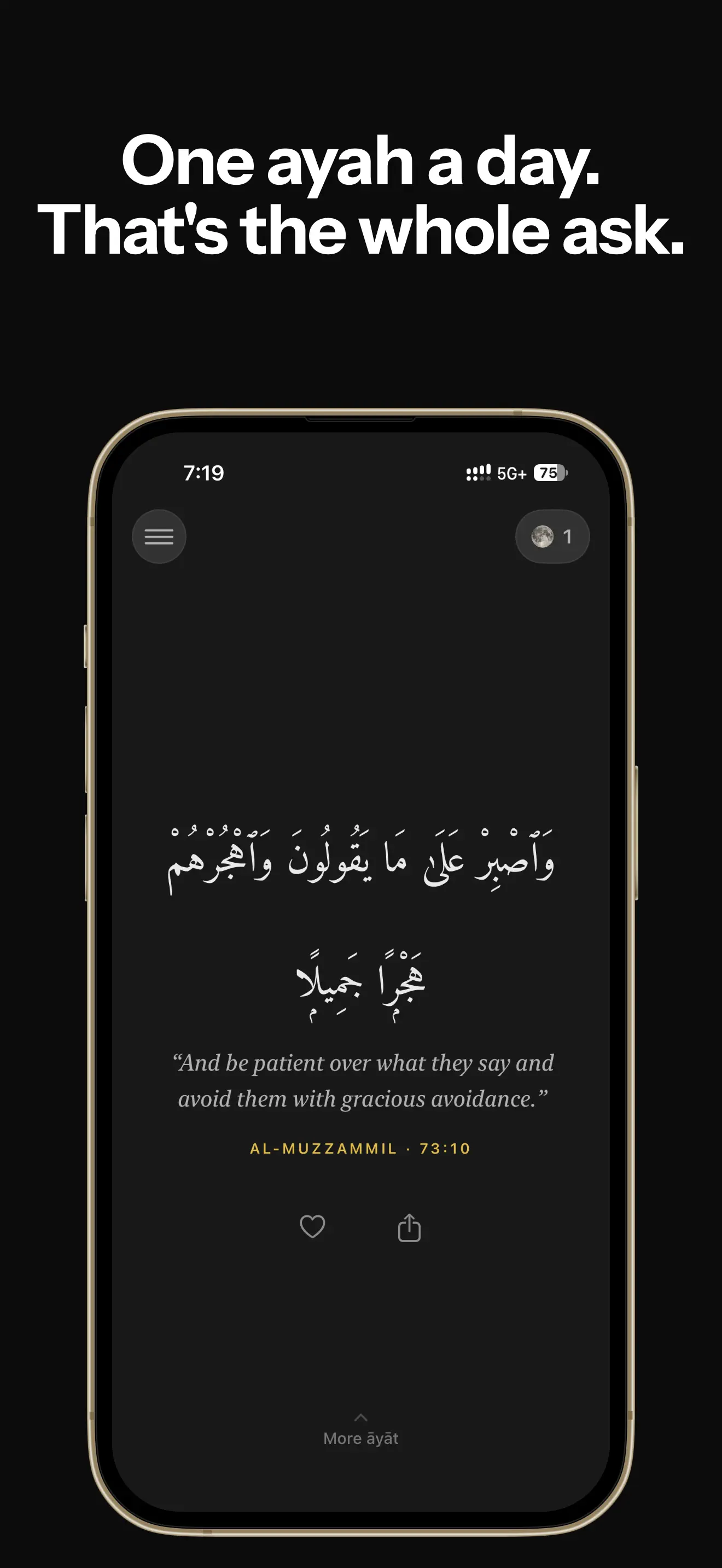
Mishkāh puts a verse of the Qur'an on your Lock Screen and Home Screen. Behind the widget sits the full text — all 114 surahs, bundled in the app — along with translations, prayer times, a Qibla compass, a dua library and a tasbih counter.
The name (مشكاة) means niche of light, from Sūrah An-Nūr. That is roughly the design brief: a small lit niche on a screen you already look at forty times a day.
No account. No tracking. Everything works offline.
The problem
Most people who want a daily return to the Qur'an do not lack the intention. They lack a moment where it is in front of them, and instead have an app that has to be opened, remembered, and chosen over everything else competing for the same tap.
The apps that exist tend to arrive with more than was asked for: a login before the first verse, a feed, notifications about things other than prayer, an ads SDK, and analytics measuring worship. Several require a connection to show text that has not changed in fourteen centuries.
The widget is the right shape for this because it inverts the problem. You do not go to it. It is on the screen you were already looking at.
What it does
Widgets
- Lock Screen and Home Screen, in every size
- Small: a single ayah in Uthmani script, typeset in SF Arabic
- Medium: ayah with translation in your chosen language
- Large: ayah, translation and a short reflection
- Circular and rectangular Lock Screen widgets for a glance
- Tap any widget to open straight to that verse in its surah
The reader
- All 114 surahs, every ayah, bundled offline
- Uthmani script, adjustable size, no clutter around it
- Juz and hizb navigation, verse search
- Tap an ayah for translation, a tafsir excerpt, and a bookmark
Prayer and direction
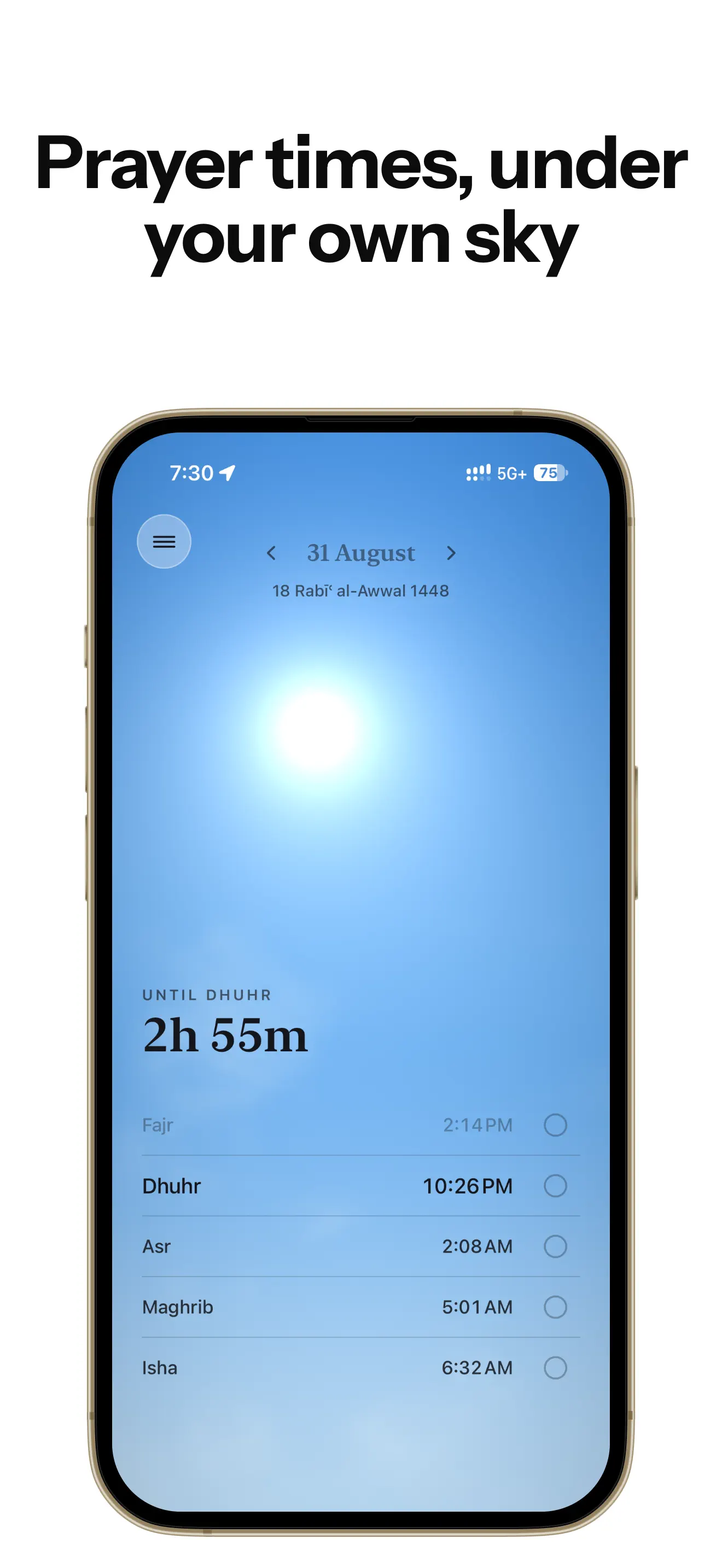
- Prayer times for your exact location
- A Live Activity on the Lock Screen counting down to the next prayer
- Adhan notifications, configurable per prayer
- Qibla compass, and a Hijri calendar with Gregorian cross-reference
Remembrance
- A dua library with transliteration and meaning
- A tasbih counter for morning and evening azkar
- The 99 Names with meanings
- Gentle daily streaks, and verses shareable as images
How it works
Built natively for iOS with SwiftUI, WidgetKit and StoreKit 2. The Qur'an text comes from the Tanzil open data project and ships inside the app, which is what makes the offline claim real rather than aspirational — on a plane, in a tunnel, on a phone with no plan, the widget still has a verse.
The design constraint throughout was restraint. Streaks that encourage and never shame. Notifications for prayer times and nothing else. No feed, no badge counts, no engagement mechanics — an app about remembrance should not be optimised for time spent inside it.
Nothing about your reading is measured or transmitted. There is no account to create and no analytics on ibadah.
Who it is for
- Anyone who wants a daily verse without opening an app to get one
- Anyone who wants the Qur'an, prayer times and Qibla in one place instead of three
- Anyone uneasy about an app tracking their worship
- Anyone whose connection is unreliable, or who reads on a device with no plan at all
Real scenarios
The lock screen glance. You check the time. There is an ayah under it. That is the entire product, and it is enough.
The prayer countdown. A Live Activity says how long until Maghrib, on the Lock Screen, without opening anything.
Travelling. A new city, an uncertain direction, and no reliable signal. Qibla works from the compass; prayer times and the full text are already on the device.
Why I built it
Because I wanted a verse in front of me without adding another thing to open, and the widget is the only interface that does that honestly.
The offline decision came first and shaped the rest. The Qur'an is a fixed text — there is no reason for it to require a network request, and every reason for it not to. Once the whole corpus ships inside the app, no account is needed, no server is needed, and there is nothing left to track even if anyone wanted to.
Alternatives and how it compares
- Quran.com and its app — outstanding, free, and the reference implementation for most people. Broader in scope, and built around a connected experience.
- Muslim Pro — enormous feature set and reach; ad-supported, with a subscription and a history of scrutiny over data practices.
- Athan and prayer-time apps — solid at prayer times, without the reader or the widgets.
Mishkāh is narrower on purpose: the widget is the product, the rest supports it, and nothing about your use of it is measured.
Pricing
The reader, the widgets, prayer times and Qibla are there from the start. Mishkāh Pro adds the large and Live Activity widgets, unlimited bookmarks and reflections, premium recitations and ambient textures, and advanced Qibla and prayer customisation — weekly with a three-day trial, or annual at the better rate.
Subscriptions renew unless cancelled at least 24 hours before the period ends, and are managed in Settings → Apple ID → Subscriptions.
FAQ
Does it work without an internet connection?
Yes. The full Qur'an text is bundled in the app. Prayer times need your location once, not a connection.
Where does the text come from?
The Tanzil open data project — public domain, and the source most Qur'an apps use.
Do I need an account?
No. There is no sign-in anywhere in the app.
Is my reading tracked?
No. There is no analytics on ibadah, and no server receiving anything.
Which iPhone does it need?
Built natively for iOS 18 with SwiftUI, WidgetKit and StoreKit 2.